Diffuse optical tomography
Diffuse optical tomography (DOT) extends channel-space fNIRS to 3-D image reconstruction. Rather than reporting one haemodynamic value per channel, DOT estimates the spatial distribution of HbO and HbR changes across the cortical surface by solving an inverse problem.
The DOT pipeline in Cedalion consists of the following steps:
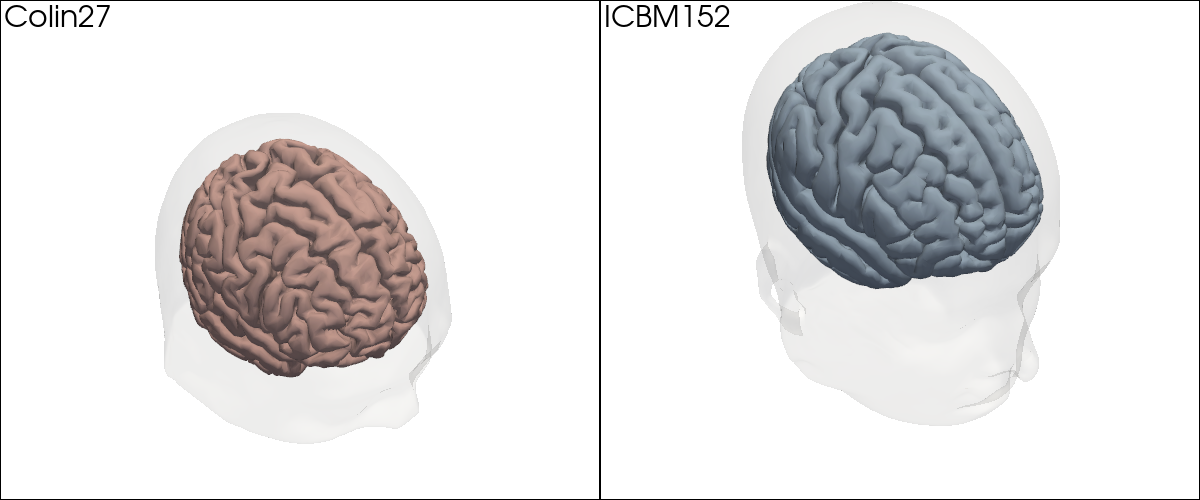
Head model construction (
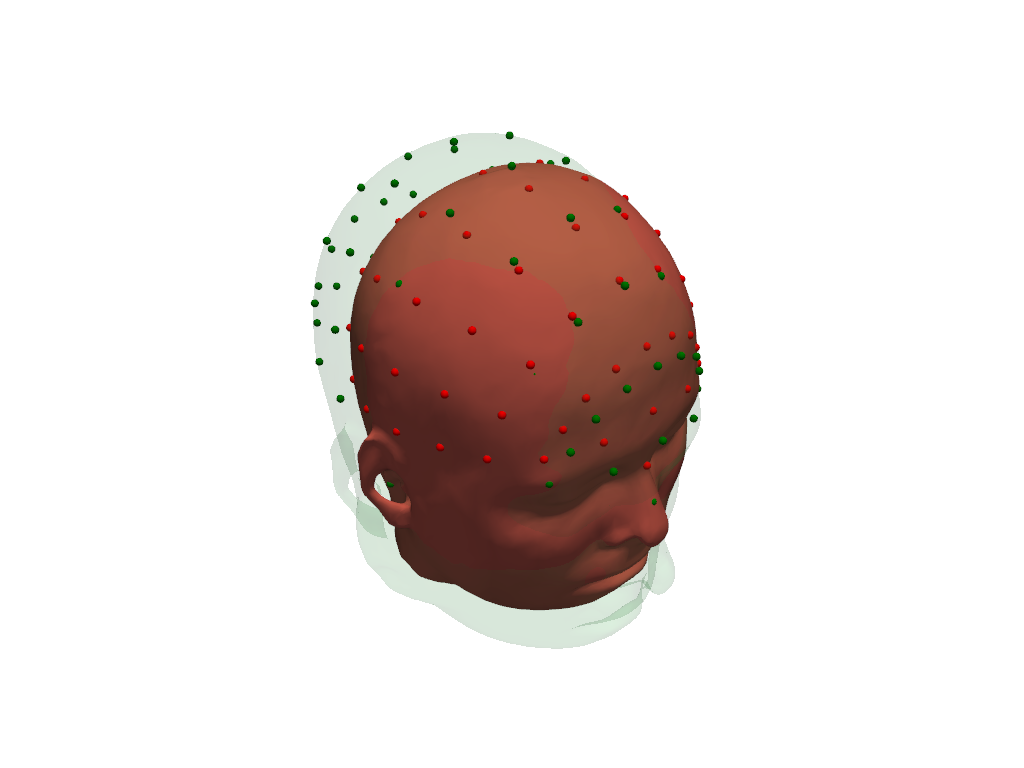
cedalion.dot.head_model) — aTwoSurfaceHeadModelwraps segmented cortex and scalp meshes, landmark coordinates, and an affine transform between sensor space and MRI space. Pre-built models for standard atlases (colin27,icbm152) are provided; custom models can be generated from individual MRI data.Optode co-registration (
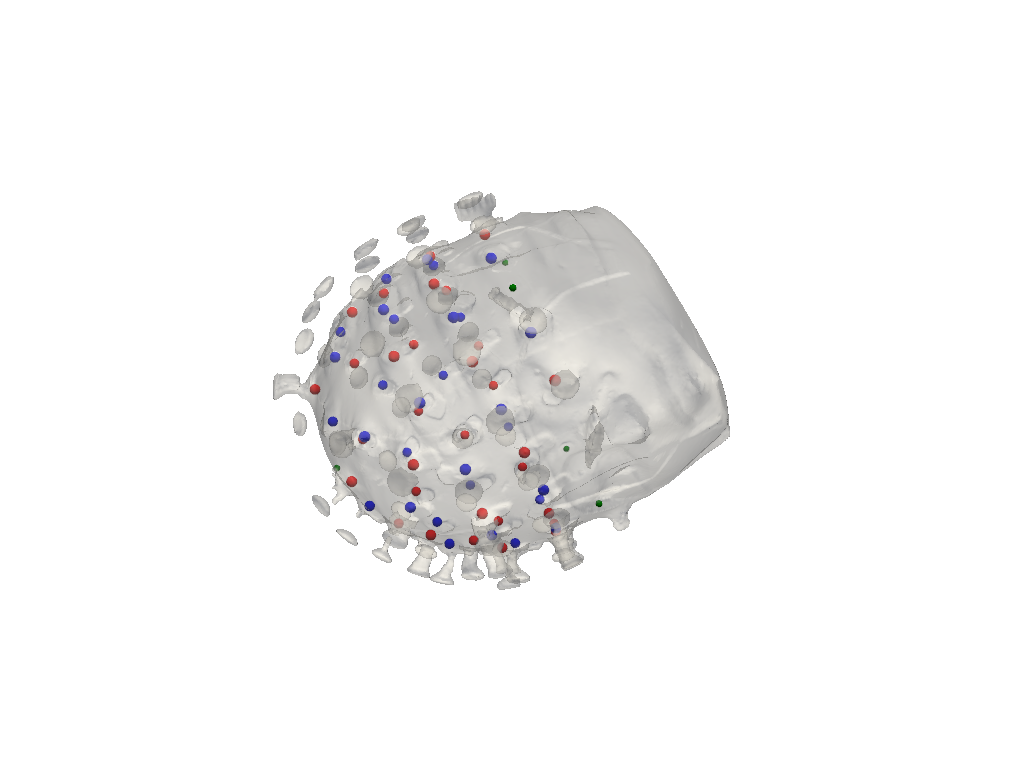
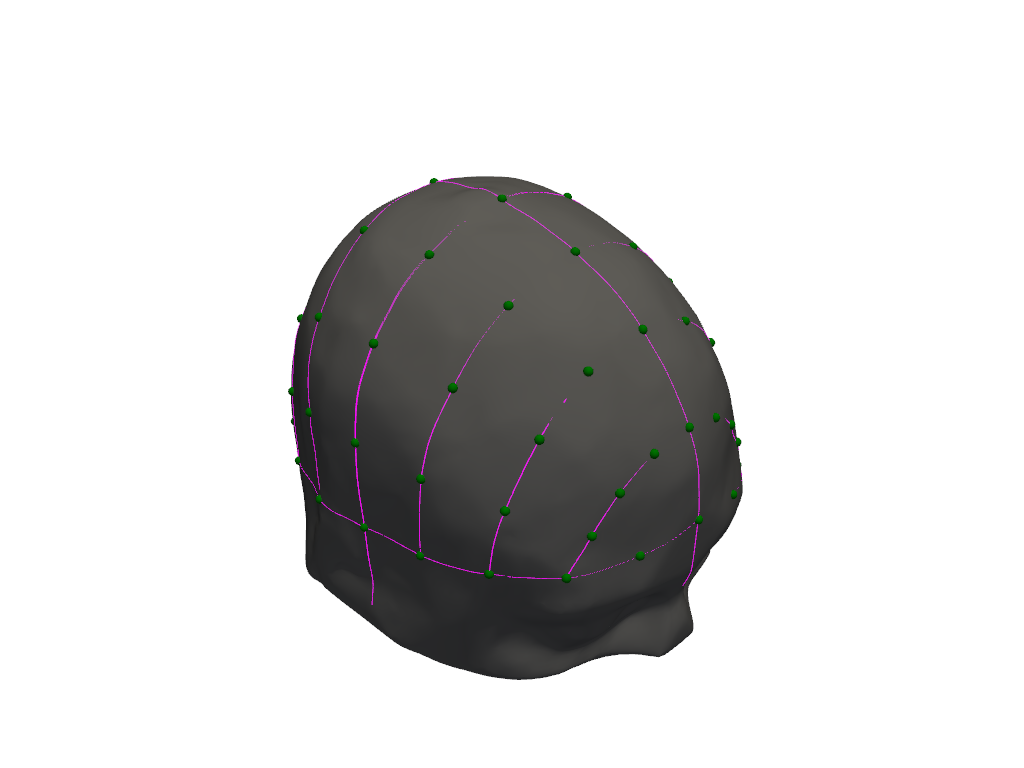
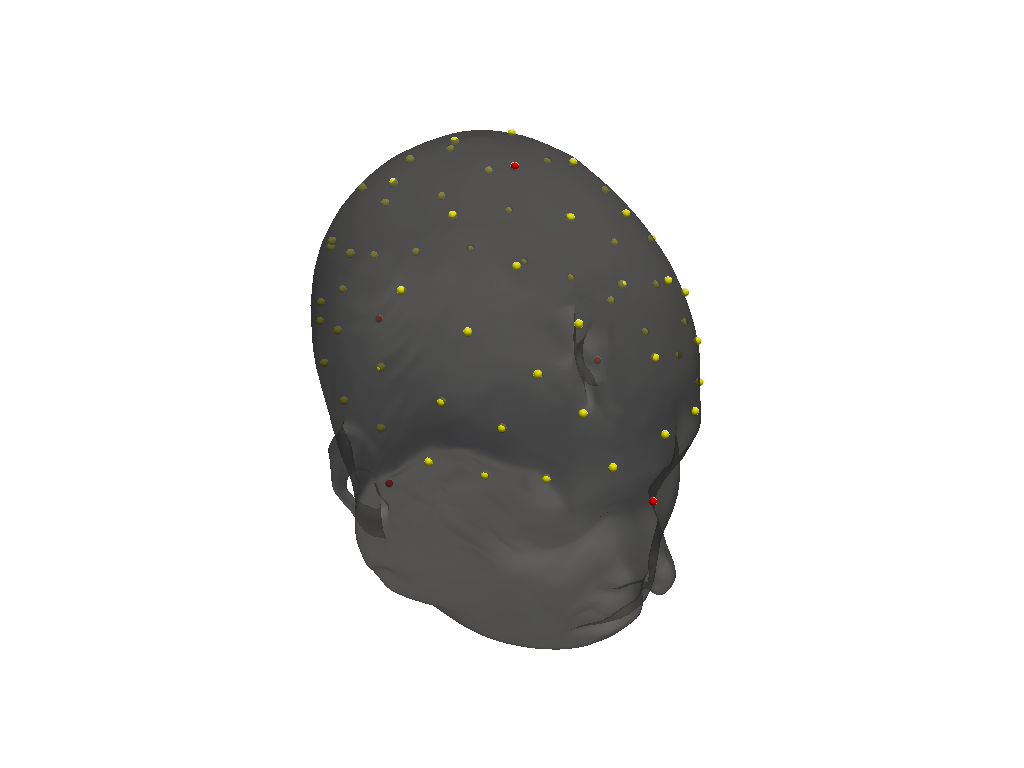
cedalion.geometry.registration) — register digitized optode positions to the head model using rigid-body or affine transforms, or via photogrammetric scalp surface matching.Forward model (
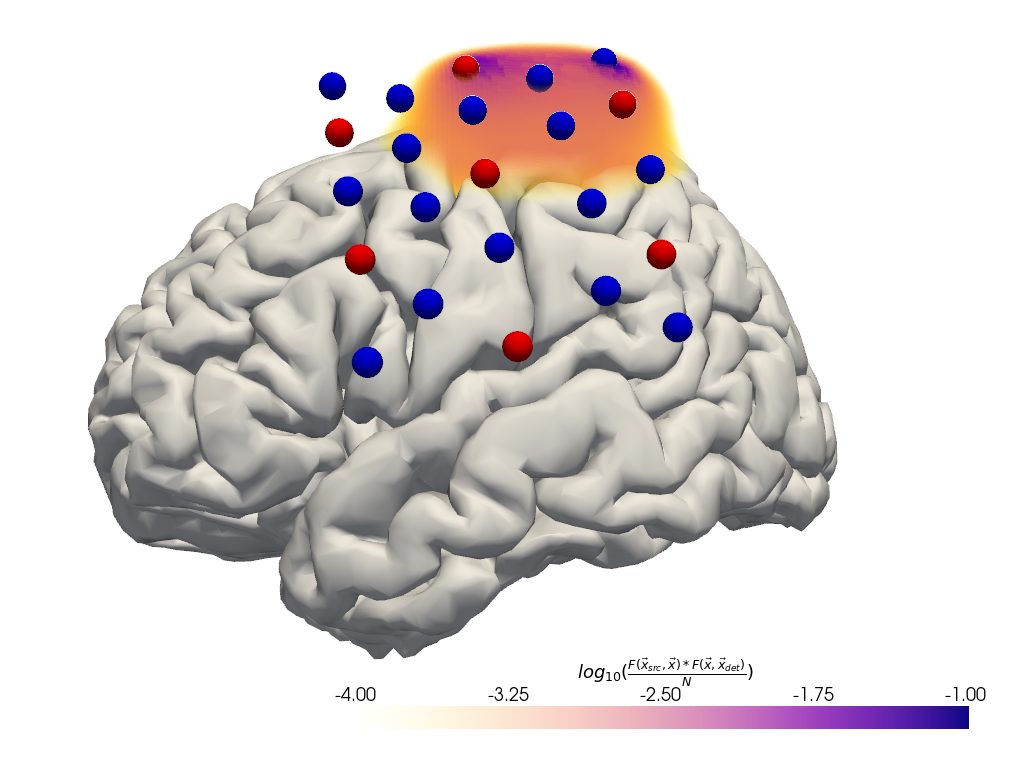
cedalion.dot.forward_model) — compute the sensitivity matrix (also called the Jacobian or A matrix) that maps cortical absorption changes to detector-level OD changes. Two simulation backends are supported: GPU-accelerated Monte Carlo (MCX, viapmcx/pmcxcl) and a finite element method (FEM) solver via the NIRFASTer plugin (requires a separate installation).Image reconstruction (
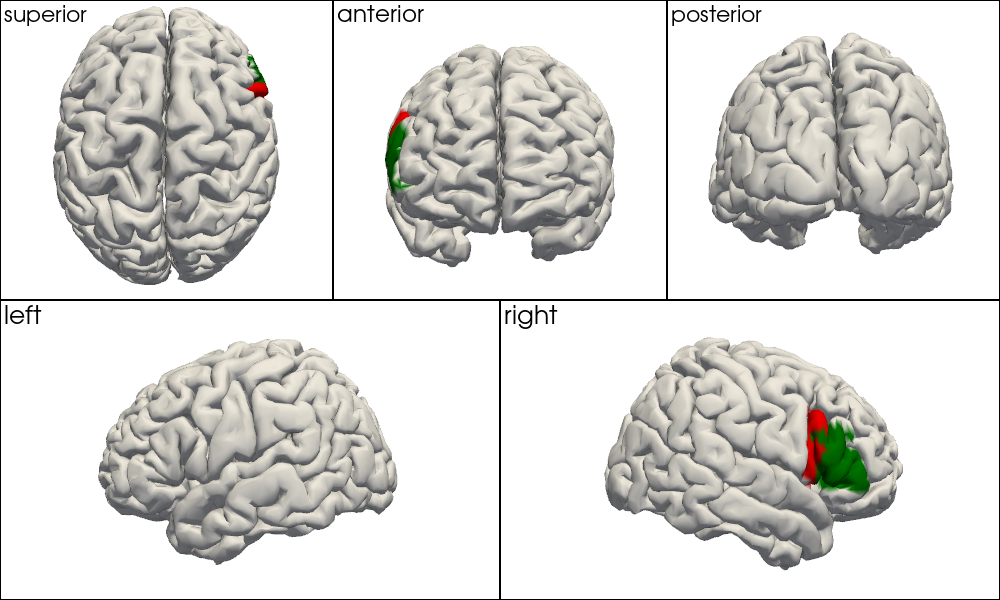
cedalion.dot.image_recon) — invert the forward model to recover the cortical image from the measured OD changes. TheImageReconclass implements a regularised pseudoinverse (Wiener filter) with configurable regularisation parameters (alpha_meas,alpha_spatial,lambda_R_conc) and optional spatial basis functions to reduce the effective number of unknowns. Reconstruction can target absorption changes per wavelength (mua), haemoglobin concentrations directly (conc), or absorption first then concentration (mua2conc).Parcellation (
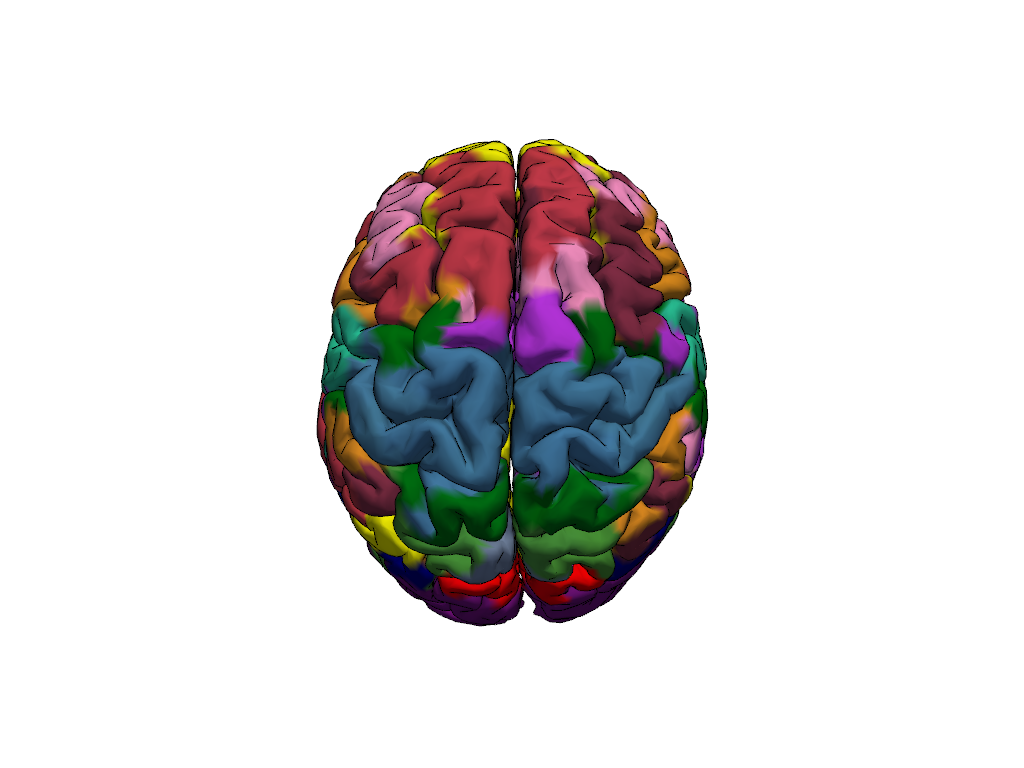
cedalion.dot.head_model) — parcel labels from the standard atlas are stored as vertex coordinates on the brain surface, allowing reconstructed vertex-space images to be aggregated to anatomical regions of interest.
Tools for geometric calculations. |
|
Examples